Since our first ratings in 2024, HIPER has been recognised with major awards, changed how helmets are sold and designed, and secured funding to rate children's helmets.
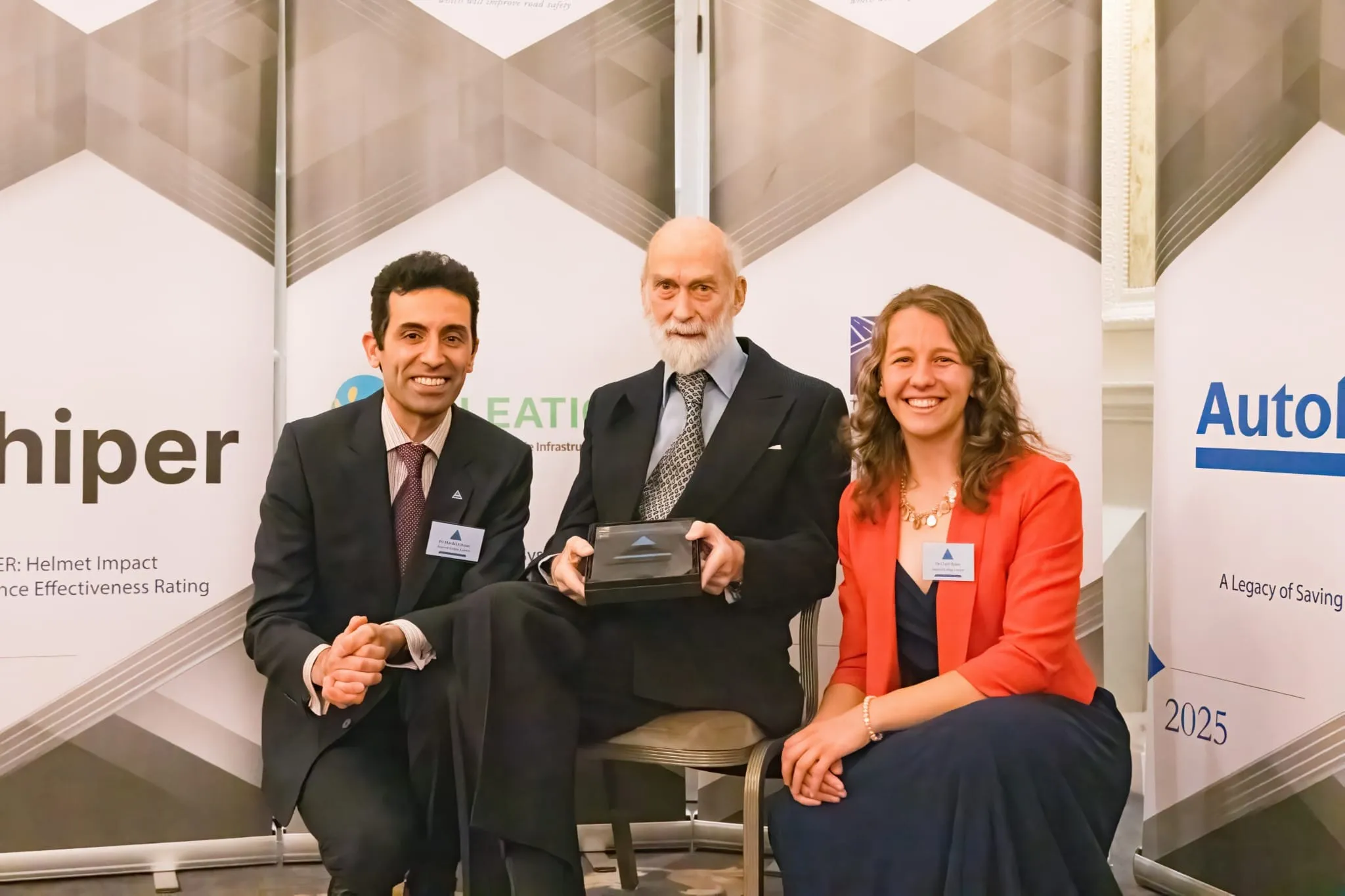
Professor Mazdak Ghajari and Dr Claire Baker receiving the 2025 Prince Michael International Road Safety Award from HRH Prince Michael of Kent.
80,000+views in the first two months, mostly from the UK, US, Australia, Canada and Germany
20,000+times the HIPER research paper has been accessed
4awards for HIPER and the research behind it
Awards and recognition
2025
Prince Michael International Road Safety Award
HEAD Lab, for HIPER
Awarded for the rigour of the rating and its real-world impact.
HIPER is built on wider research at the HEAD Lab, which also shapes helmet standards and road safety policy.
A new European standard for measuring head rotation
Working with CEN/TC158 Working Group 11, we contributed to EN 17950:2024. It specifies a new headform for oblique (rotational) impact testing, with a more biofidelic coefficient of friction and moments of inertia, addressing a key limitation of older standard headforms.
This paves the way for head rotation to be measured more widely across helmet standards. HIPER already tests with the new headform, and it has been adopted by the UK aircrew helmet standard, MAHIS v3.
Our research on e-scooter falls formed part of the evidence base for the Parliamentary Advisory Council for Transport Safety (PACTS) report to the UK government, which recommended that e-scooter riders wear helmets. It has been cited in road safety policy documents in Norway and Sweden, and referenced by the European Transport Safety Council in its recommendations on e-scooter safety.